In Chapter 1, I introduced four examples—song lyrics, junior high school math, high school math, and Einstein’s special theory of relativity—to explain the relationship between an invisible truth and its visible form of expression. In Chapter 2, I explained the idea that when different things come into contact, energy is released, using the mixing of water and the mixing of electric charges as examples. In Chapter 3, I try applying this idea to social phenomena to see whether it can help explain them.
People are also animals, and animals naturally have desires. We have an appetite because we need food to survive, and we also have a survival instinct. We naturally want to preserve our species, and we have a desire for money, which can lead to ambition and the desire to succeed. Of course, personalities differ, and some people have little desire or none at all. People who strongly want something better than what others have often feel envy or jealousy.
When I was in high school, there were students who were very good at studying, and I felt envious of them. In any society where people live together, differences appear, and those differences give rise to corresponding desires and emotions. If we assume that the desires that arise in the mind correspond to the “energy” described in Chapter 2, then the larger the gap, the greater the amount of “desire energy” that is generated.
In Chapter 2, the temperature difference between water and the voltage difference created by electric charges can be measured, so those differences can be expressed numerically. Differences in human society can be recognized, but their magnitude cannot always be expressed as numbers. However, some things can be represented by indicators—for example, test scores.
If everything became completely equal and society became “too peaceful”—with no shortage of food, no difference in living standards to envy, nothing to admire, no fear of illness or physical disability, and no gaps between people—then there would be no conflict, no mental stress, no romance, and nothing for people to strive for. Without desire, people would not try hard. Human progress might not even occur.
If everyone could enter university without an exam, then there would be no need to study for entrance exams (although I do not think people create knowledge, art, or creativity only because exams exist).
Thinking this way, desire—an energy in the mind—becomes stronger when differences exist. The greater the gap, the stronger the desire and envy. In Chapter 2, I explained that when dissimilar things come into contact, energy is released, and that energy was physical. But let us assume that “dissimilar things” are not limited to physical systems. If the same idea can be applied to differences in mentality, culture, economics, knowledge, education, physique, athletic ability, and wealth, then we can also estimate the “mental energy” released as desire. Based on this idea, I made Table 3-1 as a rough estimate.
Describing a Society in Which Energy Release Has Decreased (1)
Vol.19-24
Feb 3, 2026
Content of This Article
Describing a Society in Which Energy Release Has Decreased (1)

Table 3-1 Social Gaps and the Mental Energy They Generate (Hypothesis)
The examples above are just a few everyday cases of emotional or desire-based “energy” that came to my mind, so someone who is more sensitive or emotionally expressive might come up with even better examples.
I have tentatively proposed a social model in which, when a difference exists and people come into contact and become aware of that difference, energy is released. I believe this fits well with the physical idea discussed in Chapter 2: that contact between dissimilar things releases energy. If we accept the existence of this invisible “emotional energy” as a truth, then there should also be some form of expression that corresponds to it. As explained in Chapter 1, truth is expressed, because it can be represented in something that has a measurable size or a visible form.
To make the hypothesis easier to understand, I will use an example from everyday experience. I considered situations in which emotional energy can be expressed in a visible form or as numbers. One’s own emotional energy or desire can be consciously felt, and once it is recognized, it can be understood on a one-to-one basis.
A familiar example is a test. If you have the desire to get a good score, you study. If you study, your test scores improve. As your scores improve, your academic ranking rises, and in this way, invisible emotions are expressed in something visible.
I have a concrete personal experience related to this. When I was in my first year of high school, there were two students whose academic performance was outstanding. They were exceptional even within Yoichi District in Hokkaido, and I had already heard about their excellence when I was still in junior high school. I entered Yoichi High School, where those two students had also enrolled. At that time, the gap between their academic performance and mine was enormous—there was no real comparison. I ranked around 30th, and they felt far beyond my reach.
When I moved into my second year of high school, the school reorganized classes so that students planning to go on to university—out of about 360 students—were grouped into a single class. I ended up in the same class as those two students, and for the first time, they felt close and real to me.
This was my moment of contact with people of a clearly different “quality.”
That contact generated a mental energy—a strong desire to catch up to them. I studied hard to match their perfect scores in Japanese and English. Japanese had always been a subject in which I scored poorly, so I focused mainly on English. At the end of the summer vacation in my second year, there was a mock exam, and because the Japanese section was relatively easy, the gap in my weakest subject disappeared.
As a result, my total score caught up with theirs.
In this way, the truth that contact with dissimilar people generates desire-based energy was expressed through test scores, and that outcome was further expressed as a turning point in life—progression to university.
I chose this example because I believe it supports the hypothesis that contact between physically dissimilar things and contact between dissimilar people correspond to one another.
With this in mind, I believe the relationship between the truth that differences generate mental energy and the way it is expressed must also apply to much larger groups. Based on that idea, I would like to continue exploring social phenomena.
The following three “expressions” represent complex social phenomena in Japan whose causes are not clearly understood. There must be some invisible truth within society that is producing these outcomes. I will Tentatively set up a possible “truth” and examine whether these phenomena can be explained by it.
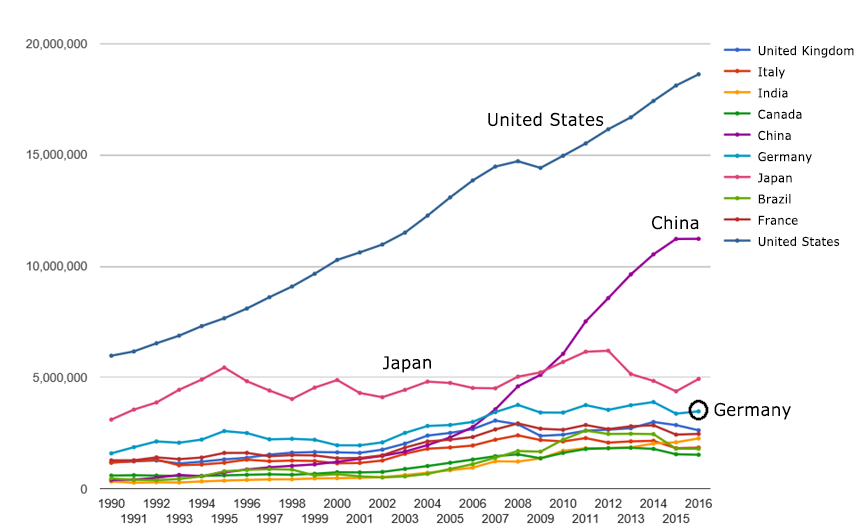
Expression 1: GDP that does not grow
Expression 2: Declining population
Expression 3: Stagnant consumption and growing financial savings (accumulated assets)
These phenomena can be expressed numerically in terms of size or quantity—in other words, they are “countable” phenomena supported by data. There is data that can be shown in graphs, shapes, and numbers.
Therefore, there must be some underlying truth that corresponds to these expressions. Even though that truth has no visible form, it should still exist. The underlying truth may not necessarily be the same for each phenomenon. However, I will assume that there is a common truth shared by all of these expressions. If such a common truth can be found, then it can be regarded as a single shared truth. There may also be clearer expressions that strongly suggest the truth. If the relationship can be explained, then that truth may be the one I have been searching for.
The truth I propose, intuitively, is a decline in the total amount of mental energy among Japanese people. When we ask what this “mental energy” consists of, it seems to include many kinds of inner desires—such as greed, material desire, appetite, the desire to marry, sexual desire, ambition, the desire for status, the desire for honor, envy, and so on. Assuming that a decrease in the total sum of this mental energy is producing these social phenomena, I illustrated this relationship in Figure 3-1.
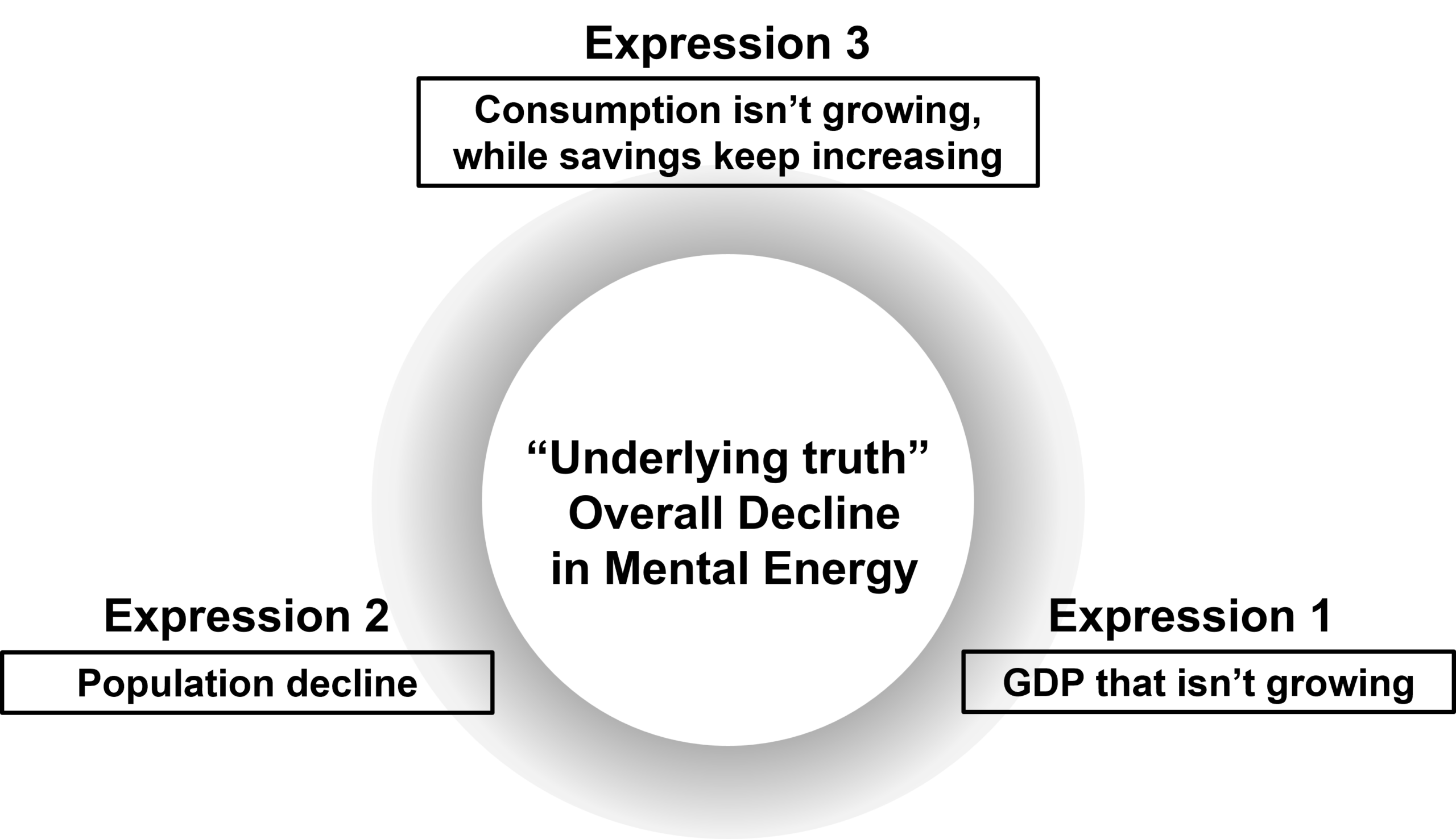
Figure 3-1 Relationship Between “Truth” of Declining Mental Energy and Its Expressions
[ Author : Y. F. ]