The second social phenomenon in Japan is the declining population. This issue can also be connected to the "hypothetical truth" of mental energy. Many people have shared various opinions about this social problem. First, let’s take a look at their perspectives.
One perspective focuses on marriage. Some people argue that the decreasing number of children is caused by an increasing number of people who choose not to get married.
I believe this is a very clear and easy-to-understand opinion.
This may seem like "common sense" that most people would not doubt. However, in some developed countries, birthrates are actually rising even though marriage rates are decreasing. In order to understand this situation, we must look at the increasing number of couples who live together without being married—which we call "cohabitation" or common-law marriage.
Even today, "common sense" for many Japanese people is that the "right order" should be "romance, marriage, pregnancy, and then childbirth." Of course, in reality, this "right order" is becoming less common. According to the White Paper on National Life published by the Cabinet Office, there is an increasing number of "pre-marital pregnancies," where pregnancy happens before marriage.
In the year 2000, these cases accounted for about 25% of all marriages. This percentage was especially high among young people, reaching 81.7% for teenagers and 58.3% for those in their early 20s, and it has continued to rise until today. Nevertheless, a key characteristic of Japanese society is that almost all couples are married by the time they give birth.
In Japan, there is a strong cultural belief that children should be born to married couples. This social norm is very deeply rooted. On the other hand, looking at Western societies, the idea that "only married couples should have children" is no longer considered obvious.
Please look at Figure 3-6, which shows the percentage of children born outside of marriage in developed countries. As of 2012, while the rate in Japan was only 2.2%, it was more than half in countries like Sweden and France. You can see that in other countries, it ranges from 30% to 50%. In short, in some countries, children born to married couples are now a minority. When we compare developed nations, we find that the birthrate is actually higher in these countries.
For example, France has a high birthrate of 1.9. In France, where divorce after marriage and subsequent remarriage are common, there seems to be a culture that is different from that of Japan.
Describing a Society in Which Energy Release Has Decreased (3)
Vol.19-24
Apr 21, 2026
Content of This Article
Describing a Society in Which Energy Release Has Decreased (3)
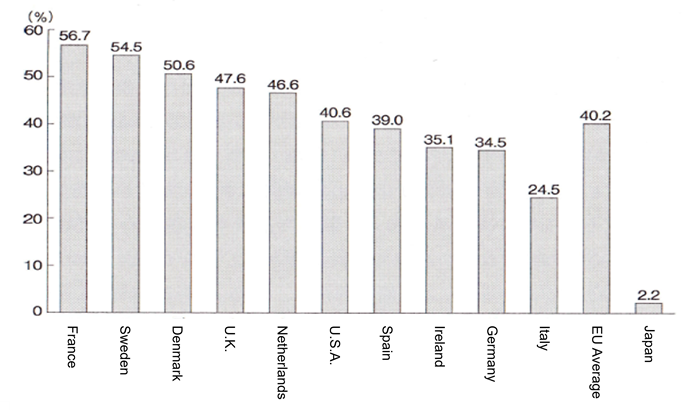
Figure 3-6: International Comparison of Birthrates Outside of Marriage (2012).
Source: Data from Eurostat (European Statistics) on the percentage of children born outside of marriage, combined with Japan’s Ministry of Health, Labour and Welfare Vital Statistics data (2.2%).
Romance is a word that is closely related to marriage. Topics about the relationship between romance and marriage often attract public attention and appear in magazines. For example, if you search for "romance scandals" involving past French presidents, you will find various interesting stories.
On January 10, 2014, the French entertainment magazine "Closer" reported that President Francois Hollande (at the time) was in a romantic relationship with actress Julie Gayet. Although the President considered taking legal action, calling it an "invasion of privacy," he did not deny the report. Furthermore, this incident did not lead to his resignation, even though his approval rating was already low. President Hollande eventually stayed in office and completed his term until 2016.
Current President Emmanuel Macron also has a unique story. When Macron was 15 years old, he fell in love with Brigitte, who was his teacher at high school. At that time, Brigitte was 40 years old and married to a local banker named André-Louis Auzière, with whom she had three children. One of her children, Laurence, was a classmate of Macron. Brigitte divorced André in 2006 and married Macron in 2007. Despite having such a "brilliant" past, Macron was elected president in 2017. When talking about romance, the word "affair" often comes up.
In France, a report about an affair cannot force a person to leave their public office. In Japan, it is almost impossible for such a person to keep their job or position. Of course, gossip magazines like the previously mentioned "Closer" do exist in France. The way these magazines report on the romantic lives of celebrities and politicians is basically the same as in the Japanese media. However, there is a big difference. While these magazines are often sued by celebrities for "invasion of privacy," the romantic stories they report never take away the person's public office or professional career.
In France, there is a culture that accepts the possibility of falling in love with someone other than one’s current partner. If that happens, the only question is whether the couple will end their current relationship or continue it. In any case, it remains a private matter between the people involved. Since an affair is not seen as a "social sin," a person’s romantic life does not define their character or personality. This seems to be the French way of thinking. We have moved a little away from the main topic of the low birthrate, but it seems that cultural differences regarding marriage are closely related to this issue.
We can recognize the different ideas about marriage in France and Japan as an international cultural gap. Originally, Japan was not a country that faced the problem of a low birthrate. I explored why the current situation has happened. I found that Takafumi Horie has shared his opinions about marriage in Japan. By comparing Japanese views with French ones, we can understand the origin of the Japanese perspective on marriage.
Takafumi Horie says, "You don't have to be tied down by the institution of marriage." He argues that marriage is basically "a system for protecting rice fields."
( Source: Toyo Keizai Online )
The following is a quote from the source:
"Do you know the origin of the family system in Japan? It goes back to the Edo period, when the Agricultural Revolution that started in 18th-century Britain reached Japan. To ensure a stable food supply, inheritance had to be safe; rice fields could not be divided and had to be passed down to only one child. This became the foundation for the tradition of prioritizing the eldest son and led to the establishment of the adoption system.
The eldest son was tied to the land where he was born. On the other hand, the younger sons and daughters were sent to work as apprentices for wealthy families and became members of other households. In this way, for many years, Japanese society allowed the eldest child to inherit the land to protect the rice fields and ensure they were passed down forever.
By tying the eldest child to the rice fields, the food supply became stable. This stability formed the foundation of Japanese society, ensuring that no one would starve, and it strengthened the system of monogamy. If the eldest child could not marry and was left alone, the land could not be maintained, which would cause trouble for their descendants and society as a whole. To prevent this, the marriage system was formalized by law, making it difficult for couples to separate or divide their assets.
In short, marriage is nothing more than a 'system for protecting rice fields.' For people living in the modern world, who have developed many other ways to produce food, this system has become completely meaningless."
When an AI summarizes Mr. Horie’s opinions, the points are as follows:
Marriage is not a mandatory system.
Individual freedom is more important than the social system.
Marriage does not necessarily solve problems; in fact, it can sometimes create more.
In particular, "marriage triggered by pregnancy" is risky.
These points suggest that the social role originally held by the institution of marriage has changed or weakened in the modern era. In other words, while marriage once functioned as a "stability device for survival," its necessity has decreased today, and it is becoming just one of many individual choices. This shift is not merely a change in values; it can be reinterpreted from the perspective of "mental energy."
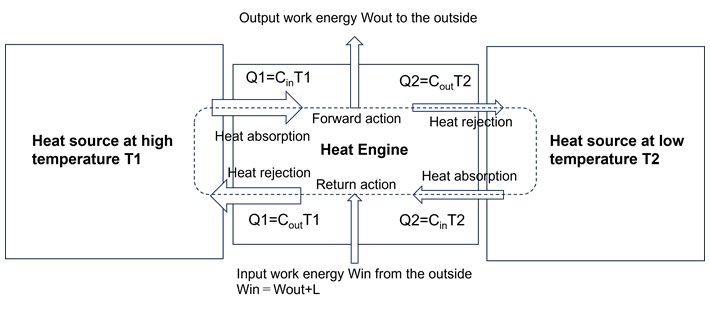
As mentioned in the previous chapter, the contact between different elements generates a release of energy. Factors such as the meeting of men and women, the awareness of economic gaps, and the realization of differences in ability all create desires and impulses—in other words, "mental energy"—within an individual. It can be argued that marriage was also originally closely related to the release of this energy. Strong interest in the opposite sex, the motivation to start a family, and the will to fulfill a social role combined to lead people toward the act of marriage. In short, marriage was a phenomenon that naturally occurred as a result of the generation and release of mental energy.
However, in modern times, the total amount of this energy is decreasing. In a materially wealthy society, the sense of urgency for survival and strong desires become weaker, and the stimulation that comes from "differences" between people decreases. As a result, the energy required to reach the point of marriage is no longer being generated.
As Mr. Horie mentioned, the fact that marriage as a system appears unnecessary today can be interpreted not as the value of the system disappearing, but as a decrease in the mental energy required to need it. In particular, his point that "marriage triggered by pregnancy" causes problems highlights the danger of entering the system without sufficient accumulation or interaction of energy.
Thinking this way, we can see that the low birthrate and the falling marriage rate in Japan are not just economic or systemic issues. Instead, they can be viewed as one expression of a more fundamental truth: "the decrease in the total amount of mental energy." The act of marriage is merely an indicator that makes the state of that energy visible.
To make this perspective even clearer, let’s compare Japan with France, which has a high birthrate. In France, values that do not prioritize marriage are widely accepted, and common-law marriage and children born outside of marriage are socially tolerated. At first glance, it seems to be a society more liberated from the institution of marriage than Japan. However, the key point is that "whether or not one depends on the marriage system" does not necessarily correspond to "the level of one’s mental energy."
In France, while people are not tied down by the system, their motivation for romance, childbirth, and forming a family remains strong. Even affairs are not condemned. As a result, the birthrate stays at a higher level than in Japan. In other words, even without depending on the institution of marriage, the energy generated from within leads directly to action.
In contrast, what is the situation in Japan? Even though the institution of marriage still exists as a social framework, the energy that motivates people to enter that system is weakening. The system remains, but the driving force that makes it function is decreasing.
This difference can be understood through the perspective of "energy release through contact with different elements," as discussed in the previous chapter. In French society, diverse values and cultures coexist, and people have many opportunities to encounter differences in their daily lives. This creates internal stimulation and accumulates the energy that leads to desires and actions. In contrast, Japanese society is highly homogeneous, and because the stimulation arising from differences is relatively small, the generation of energy is suppressed.
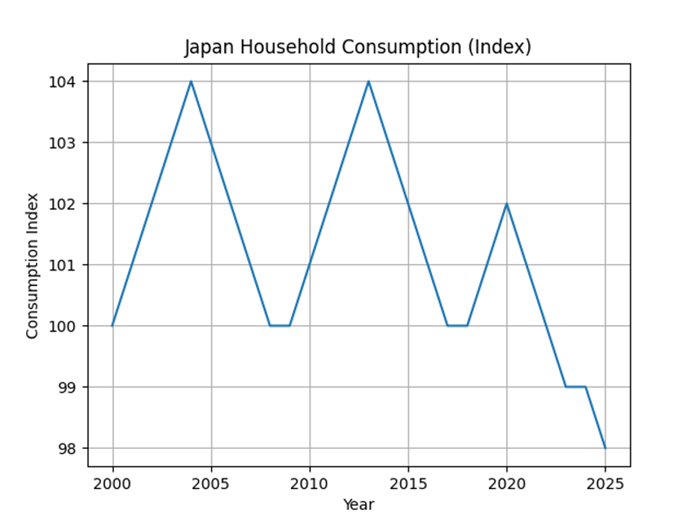
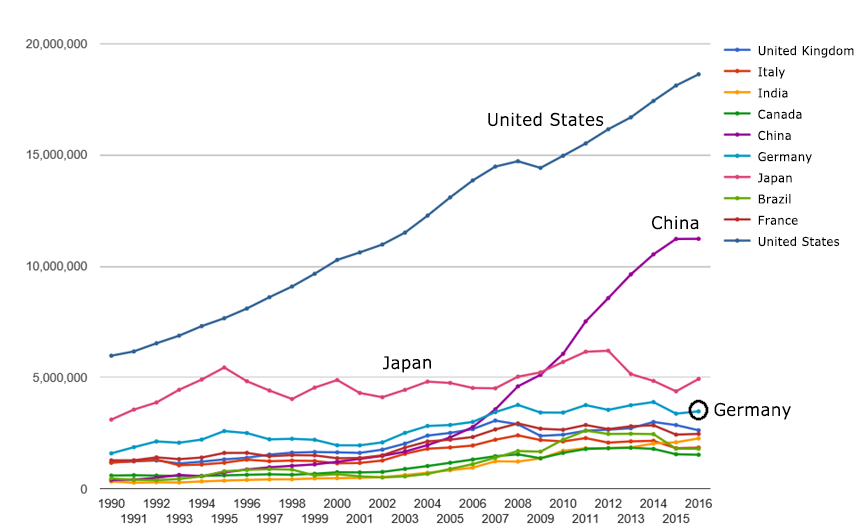
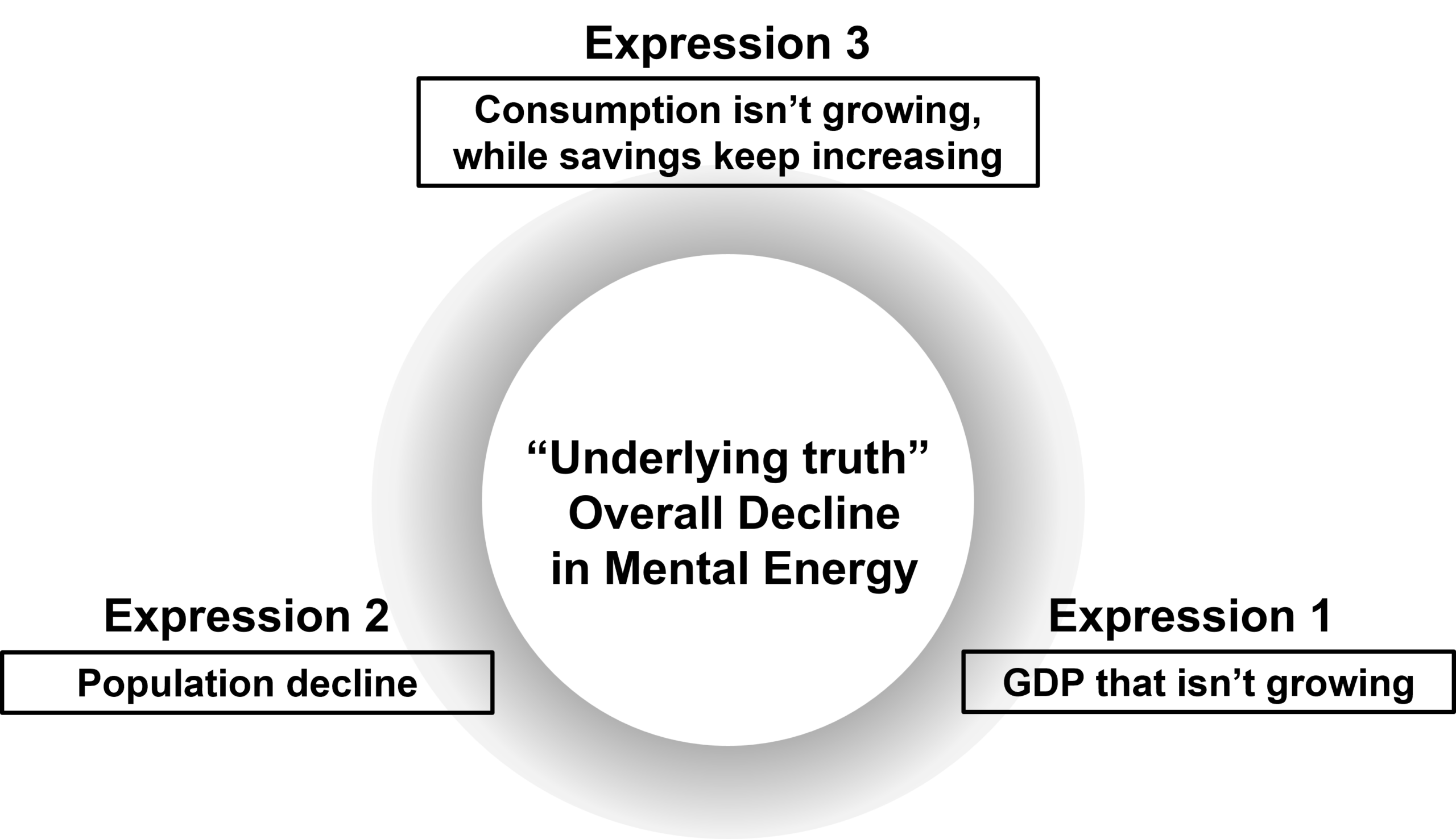
This hypothesis of the "decrease in the total amount of mental energy" is consistent not only with marriage but also with broader social phenomena. For example, the lack of GDP growth can be understood as a decline in the motivation for consumption and investment. Depopulation can be seen as a lack of the energy required for the powerful act of childbirth. Furthermore, the phenomenon where consumption does not grow and financial assets continue to accumulate is simply a sign that energy is not being released externally; instead, records of past activity merely remain as numerical figures.
At first glance, these different phenomena appear independent and unrelated. However, they can be understood in a unified way under the single hypothesis that "the total amount of mental energy is decreasing." In other words, diverse phenomena—such as the economy, population, and marriage—are merely different ways of expressing the same underlying truth.
This chapter proposes that “the falling marriage rate” and “the low birthrate” should be viewed not as separate issues, but as “expressions of a society where the release of energy has decreased”. By taking this perspective, we can see the possibility of new understandings and approaches that differ from conventional institutional reforms or economic measures.
Population decline may seem like a gradual issue, lacking a sense of urgency, because we only see it as a trend over the last 10 or 30 years. But what happens if we trace this problem back further and look at it through a history of thousands or even tens of thousands of years? In the past, the idea of a declining population was unheard of. Even when people died in wars, the population always bounced back and increased again.
What kind of era was it when there was no population decline? Conversely, what were the characteristics of societies in the past that experienced a shrinking population and eventually faced extinction? Let’s re-examine history from this perspective.
When looking back at the history taught in schools, it becomes clear that the current system of monogamy was not firmly established in Japan. This is consistent with Mr. Horie’s point mentioned earlier.
In an era where survival was the top priority, maintaining and increasing the population was essential for food production, defending against foreign invasions, and protecting lives and the nation. As a result, marriages between different groups—such as brides coming from other villages or strategic and political unions—were widely practiced. The essence of these movements was the contact between different elements. In the process where different cultures, bloodlines, religions, and values clashed and eventually mingled, the movement of people and genetic crossing proceeded naturally.
This increase in diversity is thought to have contributed not only to simple population growth but also to the enhancement of human adaptability and capability. In other words, evolutionary aspects—such as the development of cognitive abilities and improved resistance to diseases—can be explained as a result of this contact.
Furthermore, moving into the modern era, the invention of the steam engine dramatically expanded travel across both land and sea, while the subsequent invention of the aircraft greatly reduced geographical constraints. As a result, the frequency of intercultural contact increased at an accelerating pace, leading to the further "mixing" of human society as a whole.
This historical process and the trajectory of population growth appear to show the direction of a force generated by the same underlying principle. Thinking this way, the principle hypothesis emerges: that “the contact between different elements promotes population growth”. To strengthen this hypothesis, it is effective to examine the opposite case—instances where populations decreased and eventually faced extinction.
A representative example of this is the disappearance of the Neanderthals.
When different elements come into contact, a release of energy occurs. This is the underlying principle of this column, as discussed in the previous chapter. I believe this principle applies not only to physical phenomena but also serves as a powerful explanation for human evolution and social changes—particularly population decline.
The extinction of the Neanderthals was not a simple decline in population. It can be understood as a "weakening of the energy release structure." It is hypothesized that Neanderthals formed small, dispersed groups with a high degree of internal homogeneity. In such a structure, the stimulation arising from heterogeneity was scarce, and the resulting energy release from contact was likely very limited.
In contrast, Homo sapiens formed extensive networks spanning wide areas, creating contact between diverse groups. This contact amplified and sharpened the differences in culture and technology, creating a cycle where those very differences triggered further releases of energy. As a result, this gave rise to adaptability to environmental changes, technological innovation, and the expansion of the population.
Without a sufficient cycle of energy release, the Neanderthals faced the external pressure of abrupt climate change. Lacking the internal energy to adapt to these shifts, they lost the power to sustain their population. In essence, the true nature of their disappearance was not the population decline itself, but rather the fact that they could no longer release enough energy to recover and maintain their numbers. Interestingly, some of the contact with Homo sapiens manifested not as competition, but as fusion.
This was a transformation in the form of energy resulting from the contact between different elements, allowing the Neanderthals to preserve their genetic legacy in a different form.
The disappearance of the Neanderthals was a phenomenon triggered by a chain of "shrinking differences," "lack of contact opportunities," and "declining energy release."
This structure is not merely a single instance in human history; it explains the stagnation currently seen in Japanese society. The social phenomenon—or "expression"—of Japan’s shrinking population sounds an alarm: that we are approaching the same state as the Neanderthals.
The exclusion of foreigners pushes a society closer to a dangerous structure characterized by a narrow "village mentality," small isolated groups, and a homogeneous population. To highlight the gravity of this trend, I have used the extinction of the Neanderthals as an extreme example for reference.
Next, I will address the stagnation of consumption in Japanese society—specifically, the phenomenon of ever-increasing financial savings. As discussed so far, it should be becoming clear that this is also deeply intertwined with the stagnation of GDP and population decline.
[ Author : Y. F. ]